Editorial note: Uber has not publicly detailed its reasoning beyond citing a “thorough review of the business”. What follows is Chirality Partners’ analysis of the visible evidence, market conditions, competitor behaviour, and platform economics, not a confirmed account of Uber’s internal decision-making.
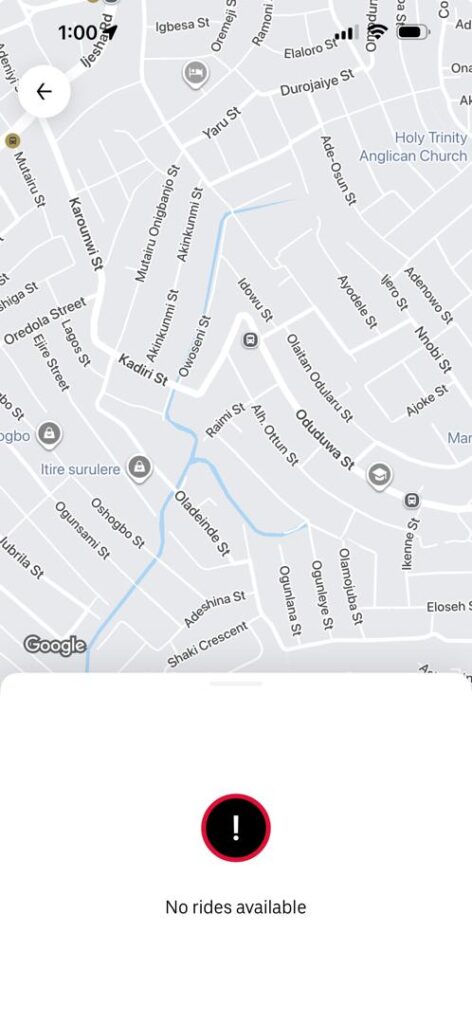
On September 2, 2026, Uber shut down its ride-hailing operations in Nigeria and Uganda, ending a 12-year run in Africa’s largest economy. The announcement came with no meaningful warning, no phased transition, and no real explanation beyond a line about a “thorough review of the business”. Users and drivers were given until September 23 of 2026 to close out account issues. That was it.
For a company that entered Lagos in 2014 with genuine ambition, expanding into boat rides, courier services, and cities well beyond Lagos, this was not a graceful exit. It was a shutdown. And it happened because three forces converged at once: a macroeconomic environment that punished Uber’s business model, a marketplace where riders and drivers had learned to route around the platform, and a company that refused to adapt fast enough to either.
This is not a story where one side is to blame. Everyone in this ecosystem – Uber, its drivers, and its riders – contributed to the collapse.
The macroeconomic terrain that broke the model
Nigeria’s operating environment turned hostile for any dollar-denominated, commission-based business. Fuel prices surged through 2023-2026, triggering repeated driver strikes. The naira’s continued depreciation quietly gutted the real value of every fare drivers earned and every dollar Uber tried to repatriate. Maintenance costs, parts, tyres, and servicing climbed in step.
Nigeria’s middle class shrank under this pressure. A salary that comfortably covered rent, transport, and a few luxuries three or four years ago now barely covers essentials. That squeeze hit the exact customer base ride-hailing depends on: people with enough disposable income to pay a premium for convenience. As that base thinned, Uber’s core economics stopped working.
The role riders and drivers played
Uber’s Nigerian revenue was hollowed out from the ground up by both sides of its own marketplace.
The offline trip. A driver arrives, cancels the ride on the app, and completes the trip for cash, often at a small discount to the rider or none. Uber collects nothing on a transaction it paid to originate. Both parties win in the moment; the platform bleeds.
The “add money on top” standoff. A driver arrives and demands more than the fare shown. When the rider refuses, they’re forced to cancel, logging as a rider-initiated cancellation rather than a driver penalty, and netting Uber a token fee instead of the fare it was owed.
Coordinated surge manipulation. In high-traffic hubs, clusters of drivers went offline simultaneously to trigger Uber’s surge pricing, then logged back on once fares spiked, turning a tool meant to balance supply and demand into a lever drivers pulled themselves.
This wasn’t fraud born of bad faith. It was a rational response to a platform that refused to move at the speed of the market around it. When Uber’s algorithm couldn’t adjust fast enough to a three-hour gridlock on the Third Mainland Bridge or an overnight fuel spike, people found ways to adjust for it themselves by any of the above-listed pointers.
Where the company’s own model failed
Uber built its Nigerian operation on assumptions that didn’t hold and never corrected course.
- A commission structure of up to 25% that assumed a margin that didn’t exist. In a market under sustained currency pressure, that take-rate was unsustainable for drivers and indefensible for the platform.
- A pricing algorithm too slow for Nigeria’s volatility. Fuel shocks and Lagos traffic aren’t edge cases; they’re routine. A system built for relative stability was structurally mismatched to the market from day one.
- A rigid, non-negotiable, cashless-first design in a market built on negotiation. This wasn’t a bug Uber could enforce its way out of. It was a fundamental mismatch between the product and the culture it operated in.
- Slower localisation than its competitors. Bolt let drivers use older, cheaper vehicles and expanded into more than twenty secondary cities. inDrive rebuilt its entire commercial model around price negotiation, cut commission to roughly 10%, and used a pre-funded driver wallet to close the exact revenue leak that was draining Uber. Both competitors treated Nigeria’s informal economy as a design requirement. Uber treated it as a violation to police.
Uber chose to fight its users’ behaviour instead of redesigning its product around it. That decision, sustained for years, is what turned a difficult market into an impossible one.
This wasn’t “Silicon Valley failing in Africa”; it was Uber failing to localise
The comfortable narrative is that another Western tech giant couldn’t hack it in Africa. That story doesn’t hold up.
Uber hasn’t left the continent. It continues operating profitably in Egypt, Ghana, Kenya, and South Africa, markets with meaningfully higher GDP per capita than Nigeria’s. This was a portfolio decision: prune the market that didn’t clear the margin bar and keep the ones that do.
And the model itself isn’t the problem. Bolt is not a Nigerian company – it’s Estonian, VC-backed, and runs a structurally similar commission-based model to Uber’s. It’s currently the market leader in Nigeria. If outside capital and platform economics were inherently unfit for this market, Bolt wouldn’t be winning with a close variant of the same playbook. The real story is narrower and more damning for Uber specifically: it had the same tools available as its competitors and chose not to use them.
What ventures on this trajectory must do differently
For founders, operators, and boards running commission-based or subscription-based models in frontier markets, the lessons here are concrete and non-negotiable.
- Build pricing that flexes with local volatility from day one. If currency, fuel, or traffic shocks are routine in your market, your pricing engine must absorb that in real time, not wait on a head-office review cycle.
- Treat the informal economy as a design requirement, not a compliance problem. Where negotiation and cash are how commerce works, a platform that punishes that behaviour loses to one that digitises it. inDrive didn’t fight the haggling culture; it built a legal marketplace around it, and it’s winning because of that choice.
- Set commission rates to what the local market can actually bear. A take-rate calibrated for a stable, high-income economy will not survive a market in double-digit currency decline. Local unit economics decide the ceiling, not headquarters’ target return.
- Read revenue leakage as an early warning, not a late-stage enforcement issue. Offline trips, forced cancellations, and surge manipulation are the market telling you your price doesn’t match its real operating cost. Ignoring that signal for years, as Uber did, is a choice, and it has a cost.
- Redesign the model before you consider retreating. Thin margins are a design problem, not proof the market is unworkable. Bolt and inDrive are proving Nigeria is profitable right now, with the same population and the same macro headwinds Uber walked away from.
- Push real decision-making authority to the local team. Every point of failure in this story – pricing, vehicle standards, driver incentives – needed a fast, local answer. A model that routes every adjustment through a distant corporate process will keep losing to competitors who can move in days, not quarters.
Uber’s exit doesn’t prove that global capital and structured platforms can’t win in Nigeria. It proves they can’t win unchanged. The ventures that win the next decade in markets like this one won’t be the best-funded. They’ll be the ones willing to let the market reshape the product, instead of expecting the market to bend to it.