
This is not sentiment. It is measurable. And the numbers make an uncomfortable case for why Africa’s most populous, most naturally endowed nation continues to underperform its promise — and what must change.
The $2.4 Trillion Question: Why Nations Diverge
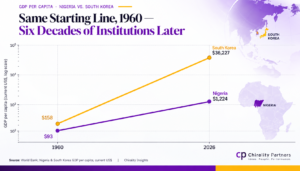
In 1960, Nigeria and South Korea were not far apart. Nigeria’s GDP per capita stood at roughly $93; South Korea’s was $158 — modestly higher, not dramatically so. Nigeria’s literacy rate was around 25 percent; Korea’s stood at 71 percent, a gap that mattered more than the income figures let on, because literacy is a proxy for institutional capacity — the ability of a population to staff, run, and hold accountable the organizations a modern economy requires.
Six and a half decades later, the divergence is staggering. Today, South Korea’s GDP per capita sits above $36,000. Nigeria’s sits near $1,200 — roughly one-thirtieth of Korea’s, despite Nigeria having significantly more people, more arable land, and vastly more oil wealth than Korea ever possessed. Korea did not out-resource Nigeria. It out-organized it. It built companies, ministries, regulatory bodies, and technical institutes that could absorb capital, discipline execution, and compound competence across decades. Nigeria, by and large, did not — or did so unevenly, in pockets, without the institutional continuity to make gains permanent.
This is precisely the pattern that Nobel laureates Daron Acemoglu and James Robinson documented across dozens of countries: nations with inclusive, accountable institutions sustain growth; nations with extractive, personalized institutions eventually stall, however strong a single leader’s vision or however rich the resource base beneath their soil. The World Bank’s Worldwide Governance Indicators — which track voice and accountability, government effectiveness, regulatory quality, rule of law, and control of corruption across more than 200 economies — exist precisely because this relationship is no longer contested among serious economists. Inclusive, well-governed institutions are consistently associated with higher incomes, better public services, and stronger job creation. Where governance is weak — marked by corruption, poor enforcement, or absent rule of law — growth stalls and social outcomes deteriorate. This is not correlation dressed up as causation. It is one of the most replicated findings in development economics.
The Nigerian Cost of Institutional Weakness
The evidence is not abstract for Nigeria. It is priced.
PwC’s landmark analysis, Impact of Corruption on Nigeria’s Economy, calculated that unaddressed corruption could cost Nigeria up to 37 percent of GDP by 2030 — a loss equivalent to roughly $2,000 per person, and a foregone opportunity of as much as $534 billion in additional GDP had the country matched the governance trajectory of comparable resource-rich peers like Malaysia and Colombia. The World Justice Project separately estimates that corruption has drained more than $550 billion from the Nigerian economy since independence. Nigeria’s tax-to-GDP ratio — a direct signal of institutional capacity to convert economic activity into public value — remains one of the lowest in the world, at roughly 7-8 percent, compared to 15-20 percent or more in peer economies with stronger institutional architecture.
Transparency International’s 2025 Corruption Perceptions Index scores Nigeria at 26 out of 100, ranking it 142nd of 182 countries — behind more than thirty other African nations, including Ghana, Kenya, Senegal, and South Africa. The score has been essentially flat for a decade. This is not a moral judgment on Nigerians; it is a measurement of how weakly institutionalized decision-making, procurement, and enforcement remain across public and private organizations alike.
And the effect compounds downward into the private sector. Nigeria’s National Bureau of Statistics reports that 92-93 percent of Nigeria’s labour force operates in the informal economy — outside the reach of formal governance, contracts, pensions, and tax systems. The informal sector generates an estimated 57-58 percent of Nigeria’s GDP, according to Moniepoint and World Economics research — a staggering share of national output produced entirely outside institutional structures capable of scaling it, financing it at reasonable cost, or transferring it intact to the next generation. Nigeria’s roughly 40 million MSMEs contribute close to half of GDP and nearly 88 percent of employment, yet fewer than half of the population’s economic activity is captured by organizations with the governance architecture to survive their founder, attract institutional capital, or expand beyond a single family or a single city.
This is the Nigerian paradox in one sentence: enormous economic energy, trapped inside organizational structures too weak to convert that energy into compounding national strength.
The Organization Is the Cell of the Nation
If the nation is the body, the organization is the cell. A nation cannot be healthier than the organizations that compose it, any more than a body can be healthier than the cells that compose it. This is where the evidence moves from macroeconomics to organizational science — and the data here is just as unforgiving.
McKinsey’s Organizational Health Index, built from more than two decades of data spanning over 2,500 organizations and millions of employee responses, has found with striking consistency that companies in the top quartile of organizational health deliver roughly three times the total shareholder returns of companies in the bottom quartile. This is not a soft, feel-good statistic — it is one of the most robust and replicated findings in organizational research, holding across industries, geographies, and economic cycles. Companies that deliberately invest in organizational health — clear direction, disciplined execution, structured accountability, capable leadership — see measurable gains in EBITDA and shareholder returns within six to twelve months of committing to the work.
The same pattern holds at the level of institutional continuity. Family-owned enterprises — the dominant structure across African commerce, including the majority of Nigeria’s MSMEs — face a brutal survival curve without deliberate institutionalization. Research popularized by the Family Business Institute and echoed across succession studies finds that only about 30 percent of family businesses survive into the second generation, roughly 12 percent survive into the third, and just 3 percent make it to the fourth generation and beyond. The single most consistent differentiator between businesses that survive generational transition and those that collapse is not talent, capital, or market opportunity — it is governance. Businesses with documented succession plans, professional management structures, and boards that separate family interest from enterprise interest survive at dramatically higher rates than those run on personality and improvisation.
This is the organizational-to-national link laid bare. A nation built on millions of enterprises that cannot survive their founder cannot, itself, compound wealth across generations. A civil service, a regulatory agency, or a ministry built around a single strong personality rather than durable institutional systems will regress the moment that individual leaves. Institutions are what allow competence to outlive the individual who created it. Nations without institutionalized organizations are nations that must restart from zero, again and again, every time leadership changes.
What Strong Organizations Actually Do Differently
Across the evidence, from the World Bank’s governance research to McKinsey’s organizational data to the family-business succession literature, a consistent pattern of what separates enduring organizations from fragile ones emerges:
They separate the institution from the individual.
Strong organizations build governance structures — boards, policies, documented decision rights — that function independently of whichever founder, minister, or manager currently holds power. This is precisely the discipline that only 30 percent of family enterprises achieve, and precisely the discipline that separates high-governance nations from extractive ones in the Acemoglu-Robinson framework.
They professionalize before they scale.
The MSMEs and public agencies that survive their first decade are disproportionately the ones that invest early in financial systems, HR structures, and defined processes — rather than depending on founder memory and personal relationships to hold the enterprise together.
They measure what they intend to improve.
McKinsey’s data shows that organizations which actively track and manage their organizational health outperform those that manage reactively. The same logic applies to nations: the World Bank’s Worldwide Governance Indicators exist because what gets measured — rule of law, regulatory quality, control of corruption — is what eventually gets managed and improved.
They build capacity that outlasts any single leader.
South Korea’s transformation from 1960 to today was not the work of one president or one company. It was the compounding output of technical institutes, disciplined ministries, and export-oriented firms that retained and transferred capability across decades and multiple changes in political leadership.
The Case for Institutional Architecture
This is the work Chirality Partners exists to do. We do not believe Nigeria, or the African enterprises and institutions we serve across the continent, suffer from a shortage of ambition, talent, or opportunity. The data does not support that theory. What the data supports is a shortage of institutional architecture: the deliberate, disciplined design of governance systems, organizational structures, and human capital pipelines that allow enterprises to survive their founders, ministries to survive their ministers, and nations to survive the turnover of any single leader.
The 92 percent of the Nigerian labour force operating informally is not a population lacking capability. It is a population trapped outside organizational structures strong enough to formalize, finance, and scale what they have already built. The 30 percent of family enterprises that fail to reach a second generation are not failing for lack of vision. They are failing for lack of governance. The 37 percent of GDP that corruption threatens to consume by 2030 is not an inevitability — it is the compounding cost of institutions that have not yet been built to resist it.
Strong nations are not built from the top down by a single reformist government, nor from the bottom up by sheer entrepreneurial hustle alone. They are built organization by organization — each one professionalized, each one governed, each one capable of outliving the individual who founded it. That is the compounding arithmetic behind every nation that has closed the gap Nigeria and South Korea opened in 1960. It is not a mystery. It is a discipline. And it is a discipline that can be built, deliberately, one institution at a time.